
The Small Grants Programme of the Global Environment Facility (GEF/SGP), under its seventh operational phase in Egypt, launched during the third week of January 2026 an extensive field evaluation mission covering four geographical regions: the Western Delta, Greater Cairo, Fayoum, and Southern Upper Egypt. This mission reflected the programme’s approach of linking community-based local action with climate objectives, biodiversity conservation, and natural resource management.
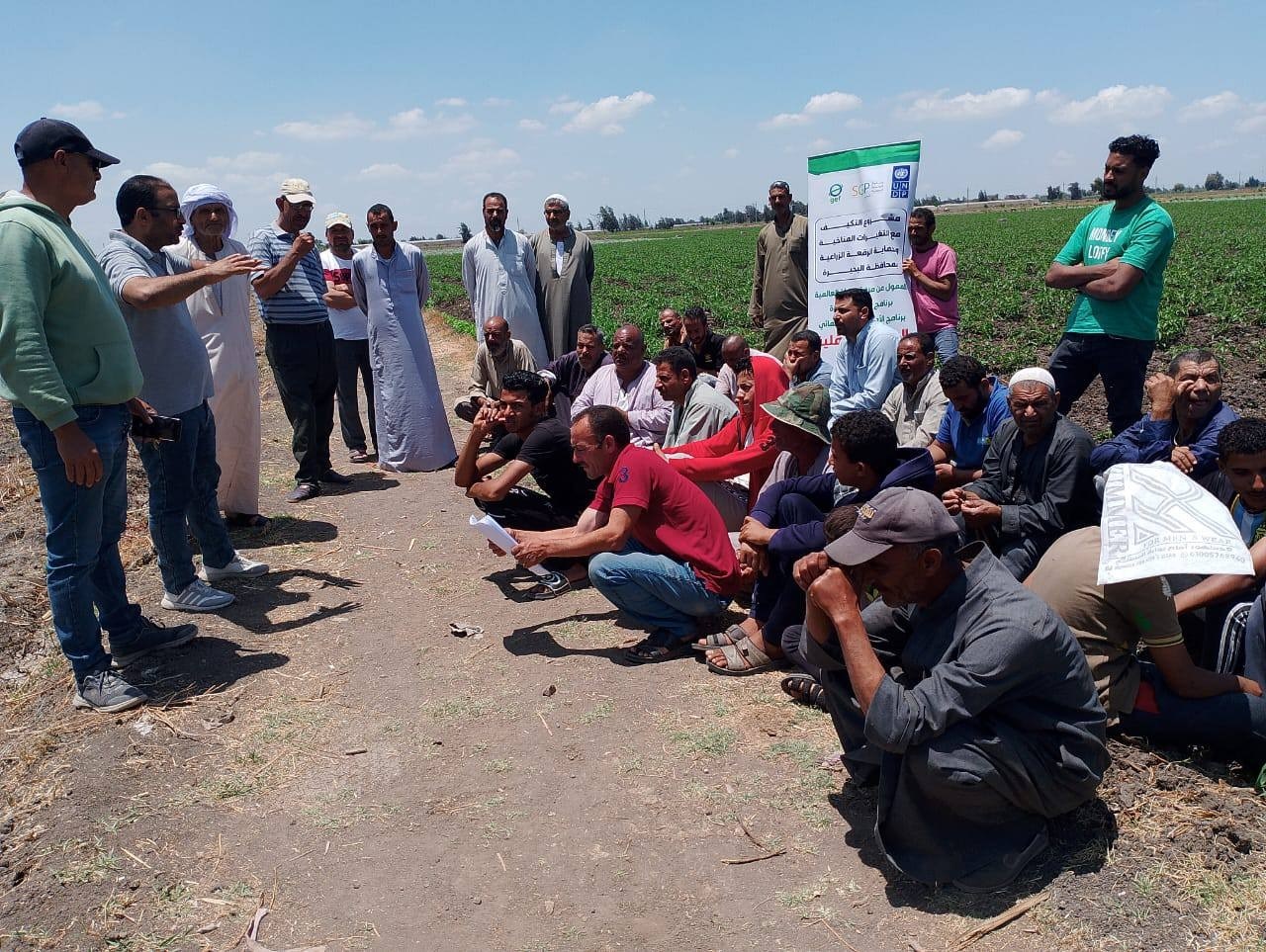
The field mission began in Beheira Governorate, where, on Saturday, January 17, the evaluation team inspected the project “Adapting to Climate Change and Protecting the Agricultural Area,” implemented by the Egyptian Association for Local Community Development in Kafr El-Dawwar. The visit focused on assessing climate-smart agricultural solutions, farmers’ capacity to adapt to water scarcity and weather variability, and the role of local platforms in sustaining interventions after the end of funding. Activities included meetings with the project team and beneficiaries, along with site visits to implementation locations.
On the following day, the mission moved to Alexandria, focusing on renewable energy and solid waste management solutions. The team visited the solar energy unit installed at the Faculty of Pharmacy, Alexandria University, as part of the project “Green Universities for a Better Future,” implemented by the Earth’s Climate for Sustainable Development Foundation. The project served as a model for integrating universities into community-based climate action. The team then headed to El-Anfoushi Youth Center to review the project “Sustainable Local Youth Communities,” implemented by the Forum for Dialogue and Partnership for Development, which combined solar energy, solid waste management, and energy efficiency, with a strong emphasis on local youth empowerment.
On Monday, January 19, the team returned to Cairo to evaluate three key interventions. These included the project “Sustainable Management of Plastic Waste and Facing Climate Change,” implemented by Al-Rowad Foundation for Projects and Development in Helwan, with a focus on plastic alternatives and women’s economic empowerment; the “Green Squares” project implemented by the Ezraa Shagara Foundation for Social Development, which relied on youth volunteers for urban greening and improving public spaces; and activities under the “Sustainable Youth Communities” project at El-Sahel Youth Center, which integrated solar energy, solid waste management, energy efficiency, and greywater reuse.
On Tuesday, January 20, the mission traveled to Luxor to evaluate three pioneering projects. These included “Together to Build Climate Resilience – The Green Village,” implemented by the Together Association for Development, focusing on agricultural waste recycling and solar energy; and “Together to Build Sustainable Agricultural Communities,” implemented by the Future Pioneers Association for Development, which integrated solar-powered irrigation systems, modern irrigation techniques, and rural women’s empowerment. On the following day, the team inspected the project “Providing Livelihood Opportunities through Recycling,” implemented by the Nour El-Islam Association. The project linked livestock waste recycling with job creation, improved living conditions, and the mitigation of pollution problems affecting the tourist city of Luxor.
On Thursday, January 22, the mission returned to Cairo for strategic meetings with the team of the “Knowledge Management, Communication, and Innovation” project, implemented by the Society for Writers on Environment and Development. This was followed by a meeting with members of the National Steering Committee (NSC), reflecting the importance of institutional learning and the sharing of lessons across projects.
After a rest day on Friday, the team headed to Fayoum on Saturday, January 24, to evaluate the “Bee Girls” project implemented by the Sinro Community Development Association, which empowered women through beekeeping. The team then visited the project “Green Model to Confront Climate Change in Tunis Village,” implemented by the Roh El-Hayat Association for Development and Dialogue, which focused on promoting the use of natural gas and energy efficiency in pottery kilns for which the village is renowned.
The mission concluded on Sunday, January 25, with meetings with the National Coordinator of the programme, followed by discussions with the UNDP office in Cairo, in preparation for drafting the final report. The report addressed the scalability of successful projects, the sustainability of community-based models after grant completion, and the degree of alignment between local action and national climate and environmental policies.
The evaluation mission demonstrated that the Small Grants Programme was not merely a funding mechanism, but a platform that transformed local communities into key actors in confronting climate change and other environmental challenges addressed by the programme. It promoted practical solutions that integrated renewable energy, resource management, women’s and youth empowerment, and circular economy approaches. The value of the programme extended from village to city, and from field to university, forming an integrated pathway that connected local development with national environmental priorities.