
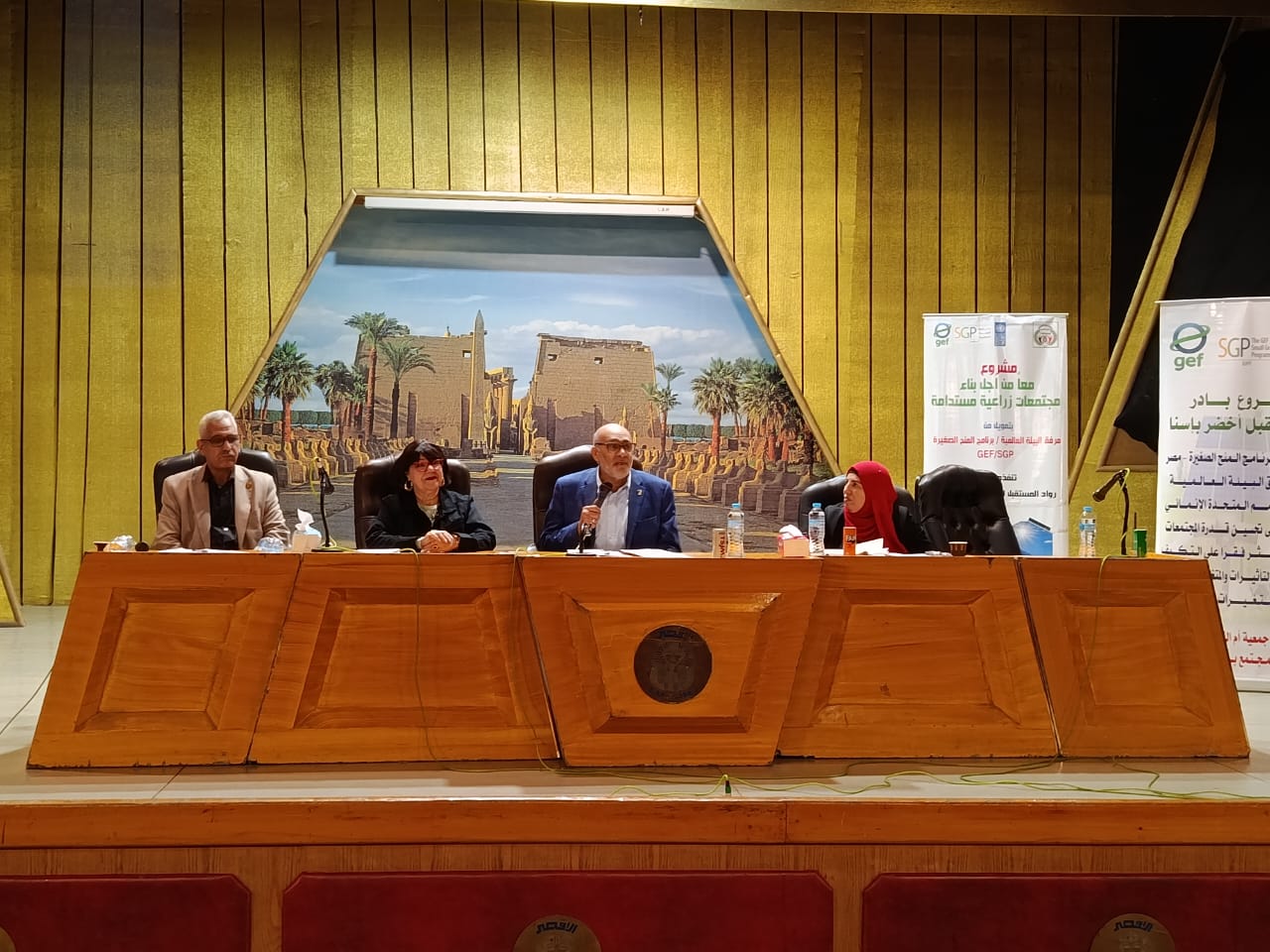
In a step reflecting its commitment to strengthening field-based follow-up, enhancing implementation efficiency, and maximizing the developmental and environmental returns of its projects, the Small Grants Programme (SGP) of the Global Environment Facility (GEF/SGP) convened the Local Platform Meeting for the Upper Egypt Region on 14 December 2025 at the International Conference Center in the city of Luxor. The meeting was held as part of a series of periodic regional meetings implemented by the Programme across the geographical areas targeted under the seventh operational phase.
Held under the theme “Monitoring Project Results and Addressing Implementation Challenges,” the meeting focused on reviewing key success indicators achieved by Phase VII projects, particularly in the areas of sustainable agriculture, women’s empowerment, and biodiversity conservation. These areas were highlighted as core pillars reflecting the direct impact of the projects on local communities in Luxor and Qena governorates. The meeting also assessed progress achieved in six projects in Luxor Governorate and three projects in Qena Governorate, in addition to discussing implementation challenges and ways to overcome them through institutional coordination and the integration of roles among relevant stakeholders.
The meeting was attended by Dr. Emad El-Din Adly, National Coordinator of the Small Grants Programme, and Dr. Hala Yousry, Chair of the National Steering Committee, along with a number of executive leaders and representatives of government entities. Participants included Mr. Refaat Mohamed Abdel Latif, Undersecretary of the Ministry of Social Solidarity in Qena Governorate; Mr. Mohamed Radwan, Director of the Environment Department in Luxor Governorate; and Dr. Amani Salah, Director of the Environment Department in Qena Governorate, in addition to representatives of civil society organizations implementing the projects and local development partners.
During the meeting, Dr. Emad El-Din Adly emphasized that local dialogue platforms constitute a fundamental pillar for ensuring the success of the Programme’s projects. He called for the concerted efforts of all partners—government entities, civil society, and non-governmental organizations—to overcome implementation obstacles and accelerate the pace of achievement, in a manner that ensures alignment with local development plans, the priorities of the Ministry of Environment, and other relevant ministries. He stressed that the objective goes beyond merely implementing activities to achieving a sustainable impact reflected in improved livelihoods, protection of natural resources, and enhanced community resilience to climate change.
He further explained that the seventh phase of the Small Grants Programme, spanning from 2022 to 2026, includes the implementation of 27 projects across seven governorates, distributed over four geographical regions: Greater Cairo, West Delta, Upper Egypt, and Fayoum Governorate. This reflects the breadth and diversity of the Programme’s interventions. He added that the Upper Egypt region holds particular significance given the nature of the environmental and developmental challenges facing its governorates, which has been reflected in the design of projects focusing on sustainable agriculture, renewable energy, eco-tourism, and climate resilience building.
In this context, projects in Luxor Governorate aim to strengthen sustainable agricultural systems, create green livelihood opportunities, support eco-tourism, and promote the use of clean energy sources in agricultural practices. Meanwhile, projects in Qena Governorate focus on combating environmental pollution, addressing agricultural land degradation, promoting the sustainable management of natural resources, and optimizing the use of agricultural waste, thereby contributing to income generation and supporting the most vulnerable groups, particularly women.
For her part, Dr. Hala Yousry, Chair of the National Steering Committee of the Small Grants Programme, stressed that one of the Programme’s core objectives is to end the state of “dependency” among local communities and transition them toward empowerment and capacity building, ensuring the sustainability of projects beyond the end of funding. She affirmed that the participatory approach adopted by the Programme—from project conception through to final evaluation—has played a significant role in strengthening community ownership of the projects and enhancing their ability to sustain and scale up results.
She noted that the experiences implemented in Upper Egypt clearly demonstrate the success of this approach, as outcomes have not been limited to environmental returns but have extended to women’s empowerment, the creation of green jobs, increased environmental awareness, and biodiversity conservation. This has generated tangible added value at both the social and economic levels and underscores the role of the Small Grants Programme as an effective development partner in supporting the state’s efforts to achieve sustainable development in Upper Egypt governorates.